Introduction
Agitated filter drying represents a critical terminal stage in the production of active pharmaceutical ingredients (APIs). During this process, a wet-cake (i.e., the product of crystallization and filtration) is dried within a vessel while being subjected to mechanical stirring; see Figure 1. The mechanical loads required to facilitate drying often induce particle attrition, particularly in crystalline APIs with elongated, needle-like geometries.
The ability to predict and mitigate this attrition across various scales is a primary challenge for the pharmaceutical industry. Because compressive and shear forces increase by orders of magnitude as mass loads shift from lab-scale to plant-scale, traditional laboratory experiments often fail to accurately replicate industrial-level particle degradation.
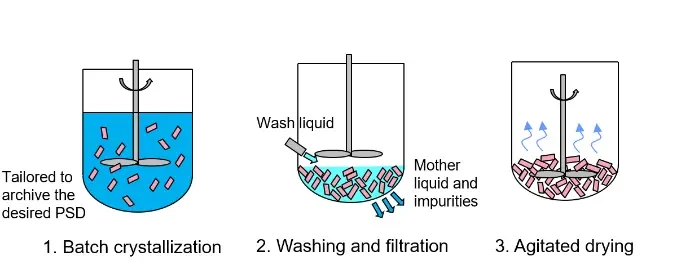
Figure 1: Representation of the main steps in API production.
The hybrid modelling approach
A collaborative research effort involving DCS Computing and several global pharmaceutical leaders, including AstraZeneca, GSK, Merck, Pfizer, Bristol Myers Squibb, and Genentech, has resulted in a novel modeling workflow designed to predict the attrition of elongated particles during agitated drying. This workflow integrates two distinct numerical methods:
- Discrete Element Method (DEM): Utilizing Aspherix® software, DEM simulations model granular flow and contact forces to estimate the mechanical torque at the agitator’s shaft.
- Two-Dimensional Population Balance Equation (2D-PBE): This model utilizes the torque and the evaporation profile data derived from DEM as primary input to calculate the resulting evolution of the particle size distribution (PSD) [1].
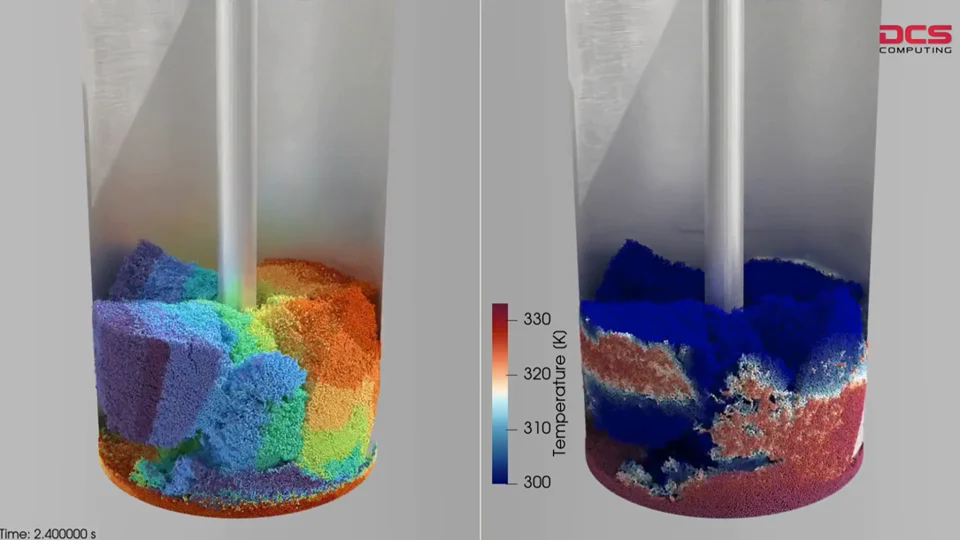
Video 1: This Aspherix® DEM simulation shows a wet-cake undergoing agitation and drying in a lab-scale agitated filter dryer. The powder's cohesivity changes with the residual solvent content, affecting the rheology of the wet-cake.
Key findings
The research focused on L-Threonine, an amino acid with needle-shaped crystals prone to fragmentation. The study yielded several critical insights into the efficacy of DEM-PBE modeling:
- Role of simulated torque: While experimental torque data is often complex and highly variable, the study demonstrated that a statistical steady-state torque derived from DEM is sufficient to predict attrition accurately.
- Model Efficiency: To simulate the drying of a wet-cake, researchers successfully compressed six hours of experimental time into a 60-second simulation by dynamically adjusting cohesion parameters to reflect decreasing solvent content; see Video 1.
- Predictive Accuracy: The final particle length distributions predicted by the 2D-PBE model showed reasonable agreement with experimental measurements for both dry and wet material conditions; see Figure 2.
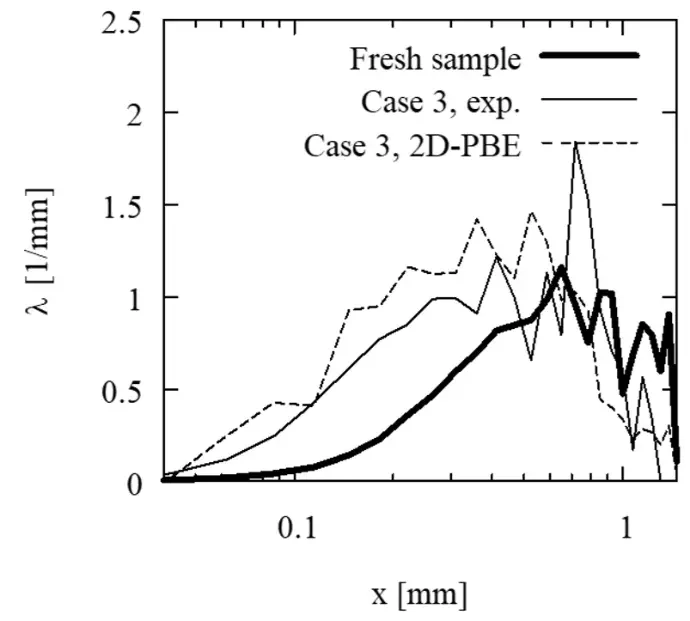
Figure 2: Length distribution of L-Threonine measured before (thick solid line) and after (thin solid line) the agitation experiment. The length distribution predicted by the calibrated 2D-PBE model is represented as a dashed line.
Impact on process development
This research, supported by the Enabling Technologies Consortium (ETC) [2], underscores the value of reduced-order modeling in pharmaceutical process development.
By utilizing Aspherix® to simulate the particle dynamics and solvent evaporation, engineers can create in-silico the input required by the 2D-PBE, bridging the gap between equipment at lab- and commercial-scale.
This "digital twin" nature of the 2D-PBE enables the industry to optimize equipment design and operating conditions, ultimately ensuring that the final API maintains its target physical properties and bioavailability.
References
[1] Togni, Riccardo, et al. "A two-dimensional population balance model for predicting the attrition of elongated particles during agitated drying." Powder Technology 464 (2025): 121198, https://doi.org/10.1016/j.powtec.2025.121198
[2] Enabling Technologies Consortium, Official website. https://www.etconsortium.org, 2025 (accessed April, 2026).
Do you want to know more?