CFDEM®coupling at a glance
CFDEM®coupling is the CFD-DEM extension for Aspherix®: it couples the Aspherix® DEM solver with a CFD solver, so particles and fluid exchange momentum, heat and mass in both directions. It comes in three packages: Premium is the base package for coupled particle-fluid simulations, and two optional top-ups extend it, Multiphase for gas-liquid-solid flows and Chemical for compressible, reacting flows.
A quick overview of what CFDEM®coupling adds to Aspherix®. The label on each card shows which package you need:
PREMIUM
Fluid-particle interaction
Drag laws for all flow regimes, lift, buoyancy and virtual mass, void fraction models for every Aspherix® particle shape, turbulence and heat and species exchange.
PREMIUM
Resolved particles & moving geometries
Immersed Boundary Method for particles larger than the CFD cells, hybrid resolved / unresolved coupling, adaptive mesh refinement and moving machine parts.
PREMIUM
Scalability & numerics
MPI parallel CFD and DEM with independent domain decomposition, coarse graining, GPU execution (beta) and robust default settings.
PREMIUM
Postprocessing & workflow
Field averaging, particle statistics in every CFD cell, ParaView output and utilities that prepare and run CFD-DEM cases.
MULTIPHASE
Multiphase flow
Gas, liquid and particles together: Volume of Fluid, Euler-Euler-DEM, bubbles, melting, evaporation and wave generation.
CHEMICAL
Reacting flow, sprays & radiation
Compressible, reacting gas flow with particle-fluid reactions, spray and film formation on particles, and radiative heat transfer.
Some Highlights
Watch CFDEM®coupling in action. These CFD-DEM simulations show particles and fluid working together in real engineering problems:
MULTIPHASE
Modeling erosion around a bridge
PREMIUM
Dynamic coarse-graining in a fluidized bed reactor (Wurster coater)
PREMIUM
Flow of water and flexible fibers through a waste water pump
MULTIPHASE
Scrap metal melting in a steel converter
PREMIUM
Resolved CFD-DEM simulation of freely spinning HPMC capsule in inhaler
CHEMICAL
Direct reduction of iron-ore with hydrogen
Fluid-Particle Interaction
In a fluidized bed, a pneumatic conveyor or a filter, what happens to the particles depends on the fluid around them, and the fluid in turn is displaced and slowed down by the particles. CFDEM®coupling resolves this two-way exchange: every particle feels drag, pressure and buoyancy from the flow, and the CFD solver sees the particles as void fraction and momentum sources.
Drag laws cover all flow regimes, from dilute transport to dense packed beds, and work with every Aspherix® particle shape. Lift, virtual mass, turbulent dispersion, suspension viscosity, electrostatic and Lorentz forces complete the picture, and heat and species are exchanged between particles and fluid in the same simulation.
Pneumatic Conveying of Particles in Arbitrary Shaped Geometries
The Ergun Showcase for Different Particle Shapes
Duct Flow in a Pipe: the Impact of the Coupling Method when Modeling Pneumatic Conveying
Resolved Particles & Moving Geometries
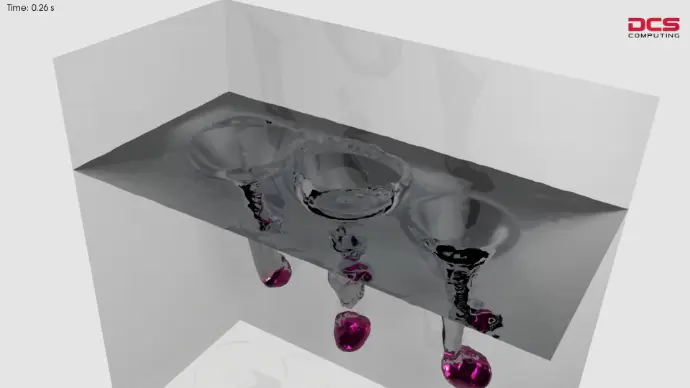
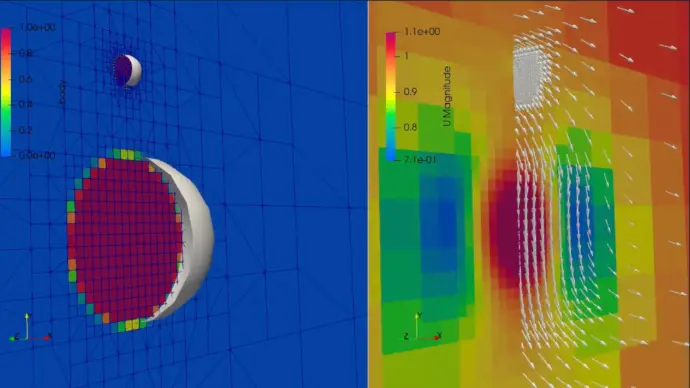
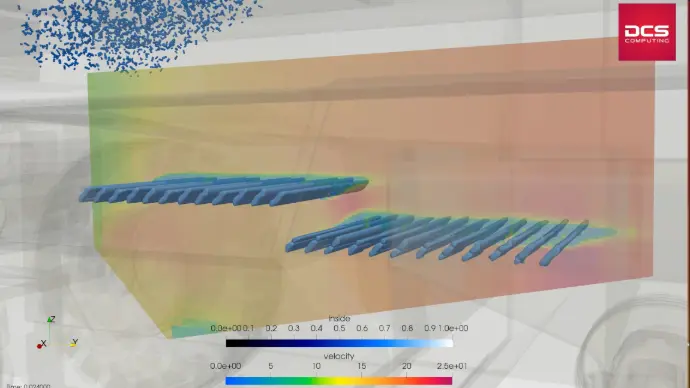
Most CFD-DEM simulations treat particles as smaller than the CFD cells. When particles are large compared to the mesh, such as pellets in a packed bed, lumps in a furnace or a single object in a flow, the flow around each particle has to be resolved. CFDEM®coupling does this with the Immersed Boundary Method (IBM).
Hybrid coupling decides per particle whether it is resolved or unresolved, and adaptive mesh refinement puts fine cells only where they are needed. The same method moves meshed geometries such as stirrers, baffles or lances through the flow.
Scalability & Numerics
Aspherix® and the CFD solver run side by side, each with its own MPI parallelization and domain decomposition. This keeps both efficient when the particles fill only part of the fluid domain, as in furnaces, shafts and fluidized beds. The workflow is the same on a workstation and on an HPC cluster.
Coarse graining represents groups of particles as larger parcels, and the scaling is applied to drag and to heat and mass exchange as well as to the contacts. Dynamic coarse graining adds detail only where it matters. On GPU, coupled CFD-DEM runs in beta via SPUMA on Linux, with both Aspherix® and the CFD solver on the GPU.
Default settings for robust or precise runs, smoothing of coupling fields and stability checks make coupled cases easier to set up and keep them stable.
Dynamic coarsegraining for where details matter
Simulation of a dry powder inhaler with 1 million particles on GPU
Simulation of an industrial scale rotary kiln on an HPC CPU cluster
Postprocessing & Workflow
Coupled simulations produce two kinds of data: particle data from the DEM and fields from the CFD. CFDEM®coupling brings them together, maps particle quantities onto the CFD mesh and averages fields in time, so you get numbers such as slip velocity, local particle concentration or total momentum exchange.
Results are written for ParaView, including particles with temperature and pathlines, and utilities decompose, reconstruct and export CFD-DEM cases. Wrapper scripts run and clean up a coupled case with a single command.
Multiphase Flow
Many processes have more than one fluid: particles fall into a liquid bath, gas is blown through a particle-laden liquid, a melt forms and flows. The Multiphase package adds solvers for gas, liquid and particles in one simulation.
The Volume of Fluid (VOF) solver tracks the gas-liquid surface, so particles can float, sink or sit at the interface, also as non-spherical particles. The Euler-Euler-DEM solver handles interpenetrating fluid phases, for example in bubble columns or gas-stirred baths. Particles can melt into the liquid or evaporate, and wave models generate and absorb waves for coastal and offshore cases.
Injection molding with flexible fibers
Imbibition of a resolved particle bed
Sand erosion on a beach
Reacting Flow, Sprays & Radiation
In kilns, gasifiers, reduction reactors and dryers, the gas reacts with the particles, heats them, dries them or burns them. The Chemical package adds a compressible, reacting CFD-DEM solver for these gas-solid systems.
Reactions take place in the gas and between gas and particles, and the reaction rates account for the local void fraction. Particles change their mass as they react. Sprays wet the particles and form films on them, and radiation transports heat at high temperatures. Particle temperature statistics and additional output formats come with the package.
Combustion in a Rotary Kiln
Particle Granulation in a Wurster Coate
Thermal Runaway of a Li-Ion Battery
Full Spec Sheets
Need more details? Download the Spec Sheets for the different CFDEM®coupling packages here:
Which CFDEM®coupling setup fits your process?
Book a call with our engineers. We look at your process together and recommend the right packages, or set up a free trial for your own case.