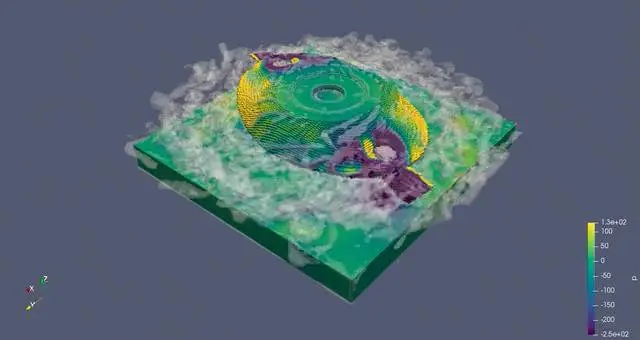
Together with PÖTTINGER Landtechnik, DCS Computing simulated the air flow in a mower deck whose rotating blades sweep overlapping paths, compared design variants for better cut quality, and modelled grass as flexible fibres.
At a Glance
Customer
PÖTTINGER Landtechnik GmbH
Question
Which deck geometry and boundary conditions give the air flow for the best cut quality?
Method
Immersed boundary model for the blades in CFDEM®coupling; grass as multisphere fibres in Aspherix®
Validation
Checked against a sliding-mesh solution; air flow rates correspond to the available experimental data
The Challenge: Blades Whose Paths Overlap
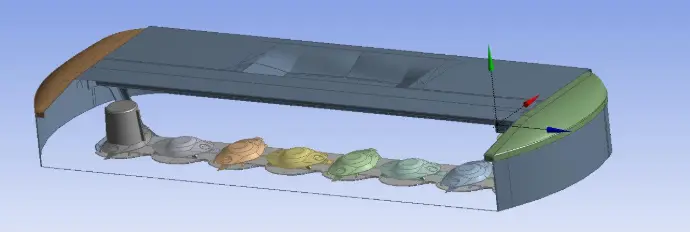
A mower deck carries several rotating blades side by side. Their paths intersect, so the space each blade sweeps overlaps with its neighbours. The air flow these blades create influences how the grass is cut, and PÖTTINGER wanted to improve cut quality by optimising the deck.
The standard way to simulate rotating parts in CFD is the sliding mesh: each rotor gets its own mesh zone that turns with it. That only works when the zones do not overlap. For intersecting blade paths, sliding mesh is not applicable, so a different approach was needed.
The Approach: an Immersed Boundary Model Built for Mower Decks
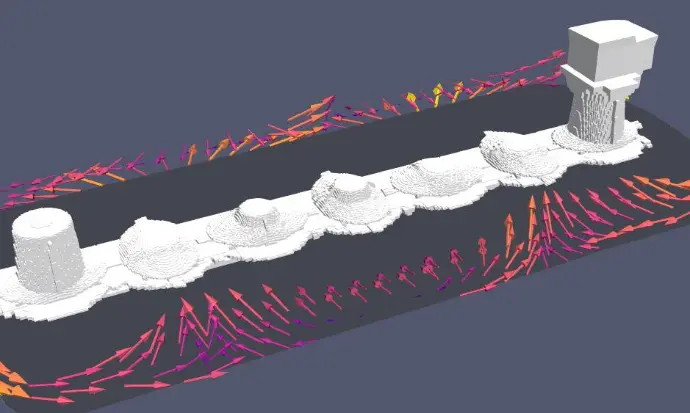
DCS Computing modelled the moving blades with an immersed boundary (IB) technique developed specifically for mower deck applications in CFDEM®coupling. The blades move through a fixed fluid mesh instead of carrying their own mesh, so intersecting paths are no longer a problem.
Before using it for design work, the method was validated against a sliding-mesh simulation of a configuration where both approaches can be applied.
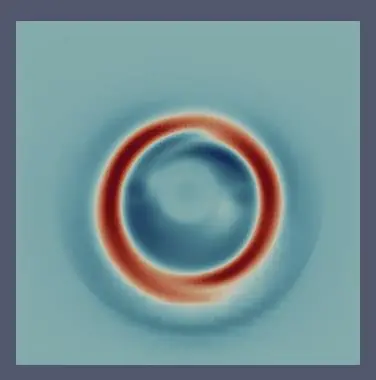
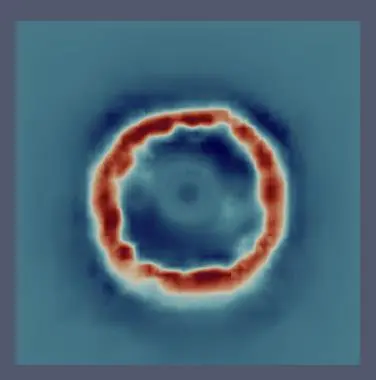
Validation of the immersed boundary method against sliding mesh.
Results: Design Variants Compared Before Building Them
With the validated model, different deck geometries and boundary conditions were investigated and optimised. For each variant, the simulation tracks the air flow rate over time through the sides, the inlet and the outlet of the deck. The simulated data corresponds to the experimental data available.
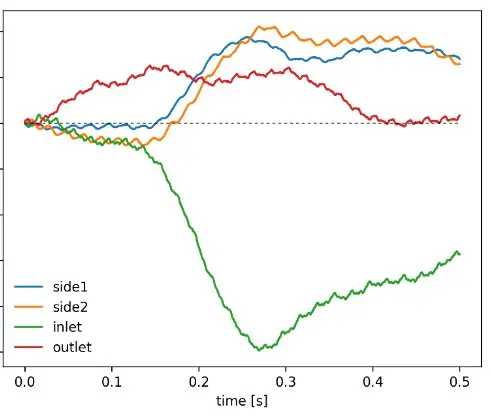
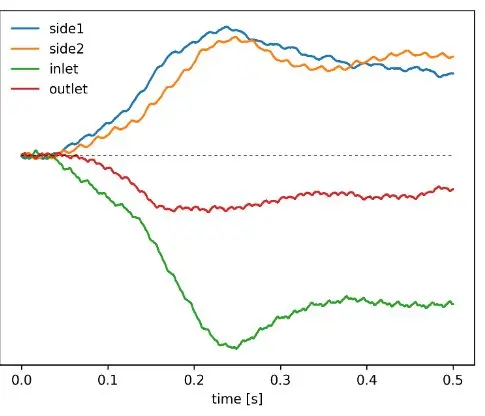
Two setups compared: air flow rate at the deck boundaries over time.
Next Step: Grass as Flexible Fibres
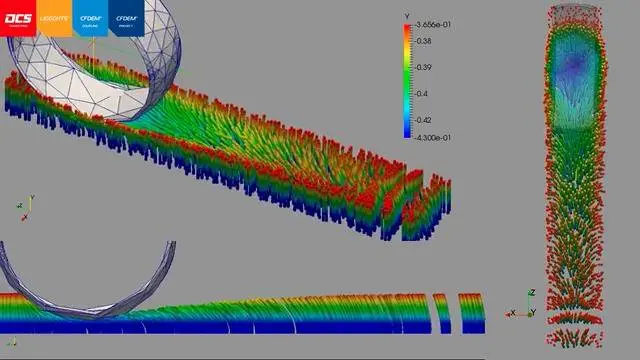
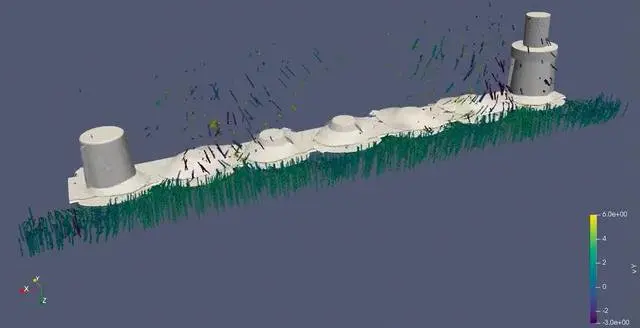
In Aspherix® DEM software, grass leaves are modelled as fibres made of multisphere bodies with elastic and damping forces between the spheres, in normal and tangential direction. When a wheel rolls over them, the fibres bend and then move back towards their original shape.
In CFDEM®coupling, these flexible fibres can be cut and coupled to the complex air flow in the mower deck. This links the air flow directly to what happens to the grass.
“With DEM being a relatively new and emerging method (compared e.g. to the Finite Element Method), it was very important for us to collaborate with a highly knowledgeable, reliable but also responsive software partner. We are pleased to say that DCS Computing has been living up to those expectations for years and are looking forward to more exciting projects together in the future.”
Related Applications
The immersed boundary approach suits any machine with rotating tools whose paths overlap. These pages show related work:
Harvester separation on GPU
Immersed boundary CFD-DEM of grain separation over a moving chaffer. See the agricultural machinery cases.
Calibrated soil and crop models
How material parameters are matched to lab tests. See the calibration workflow.
Moving geometries in CFD-DEM
Immersed boundary, AMI and moving meshes. Explore CFDEM®coupling.
Questions About Mower Deck Simulation
Why can't a sliding mesh be used for a mower deck?
A sliding mesh gives each rotor its own rotating mesh zone, and the zones must not overlap. In a mower deck the blade paths intersect, so the zones would overlap. An immersed boundary model moves the blades through a fixed mesh and avoids this limitation.
How was the immersed boundary model checked?
It was validated against a sliding-mesh simulation of a configuration where both methods apply. In the design study, the simulated air flow rates corresponded to the experimental data available.
Can grass be simulated with DEM?
Yes. In Aspherix®, grass leaves are modelled as flexible fibres made of multisphere bodies with elastic and damping forces between the spheres. In CFDEM®coupling the fibres can be cut and coupled to the air flow.
Rotating tools in your machine?
Talk to the engineers who built this model about your design question.