Key finding: modelling bentonite slurry particles as spheres over-predicts how deep they infiltrate the soil. Flat, non-spherical particles clog near the surface and build an external filter cake. Jiayuan Liu and Kevin J. Hanley at the University of Edinburgh showed this with coupled CFD-DEM in Aspherix® and CFDEM®coupling.
Why Filter Cakes Matter in Tunnelling
Slurry shield tunnelling is often used for undersea tunnels. It relies on a filter cake of low permeability that forms where the slurry meets the soil at the tunnel face. Earlier CFD-DEM studies of this process represented the bentonite in the slurry as spheres. Real bentonite, however, consists of flat clay platelets, and particle shape strongly affects packing. The research, part of a PhD project on slurry infiltration in granular soils, asked how much the shape changes the result.
Simulation Setup
- Particles: slurry particles as oblate spheroids (superquadrics in Aspherix®) with aspect ratios 1 (spheres), 3 and 5; sand as monodisperse spheres six times larger than the slurry particles.
- Fluid: water modelled in OpenFOAM®, coupled through the non-spherical CFDEM®coupling module.
- Fluid forces: drag (Hölzer and Sommerfeld), lift and pitching torque (Zastawny et al.), viscous and pressure-gradient forces. The pitching torque makes a settling ellipsoid turn its long axis across the direction of motion, as known from direct simulations of a settling ellipsoid (Pan et al., 2002).
- Contacts: Hertz model with mean curvature radius; adaptive cohesion between slurry particles; friction 0.3 (sand) and 0.05 (slurry).
Results: Flat Particles Stay at the Surface
Spherical slurry particles penetrate deep into the sand column. With aspect ratios 3 and 5, the particles clog the upper part of the column and form external and internal filter cakes. Near the top of the column, the void fraction is clearly lower than with spheres, and the pressure drop moves towards the sand surface as the aspect ratio grows.
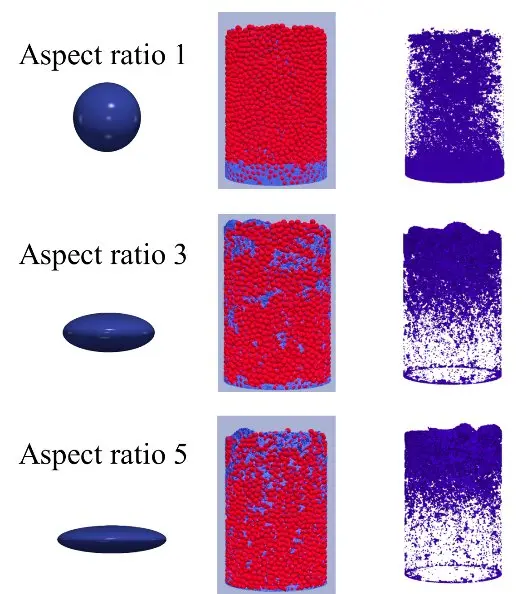
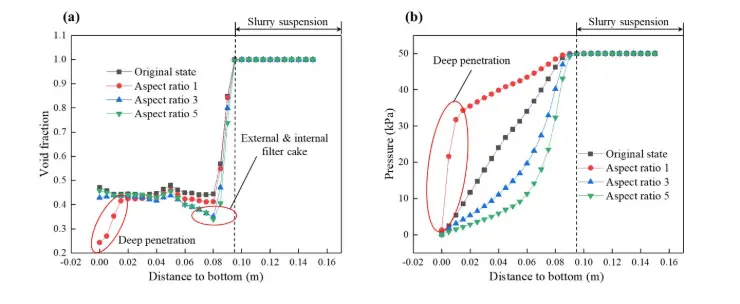
“Using spherical particles to represent what in reality are non-spherical particles leads to an over-prediction of infiltration distances in the simulations.”
Next, the team will extend the study to more aspect ratios, vary the size ratio between sand and slurry particles and analyse how the spheroids orient within the filter cake.
What This Means for Engineering Practice
Whenever fine particles are flat or elongated, spheres can give the wrong answer, here on how far slurry penetrates the ground. Aspherix® and CFDEM®coupling combine superquadric shapes with shape-aware fluid forces, so the particle shape can be part of the model. See CFD-DEM with CFDEM®coupling, or browse the civil and hydraulic engineering cases.
Research and results: Jiayuan Liu and Kevin J. Hanley, School of Engineering, University of Edinburgh. Published with permission. The pitching torque implementation was presented by O. Erken at the 4th Aspherix® & CFDEM® Conference, Linz, April 2023.