Short answer: three spheres or more reproduce bulk behaviour such as angle of repose, hopper flow and mixing for a spherocylinder particle. More spheres improve the shape but strongly damp collisions with several contact points and need a smaller time step. That is the result of a systematic study by Procter & Gamble, who compared 2- to 9-sphere particles in seven tests.
The Question Behind the Study
Multisphere (clumped sphere) particles are a common way to represent non-spherical grains in DEM: overlapping spheres are glued together into one rigid body. The more spheres, the closer the surface comes to the real shape, but each extra sphere adds contacts and cost. P&G wanted to know where the trade-off lies.
All tests used a spherocylinder (a cylinder with hemispherical caps, cylinder height twice the cap radius), represented by 2, 3, 4, 5, 7 or 9 equal spheres spaced evenly along its axis.
Results of the Seven Tests
| Test | Setup | Finding |
|---|---|---|
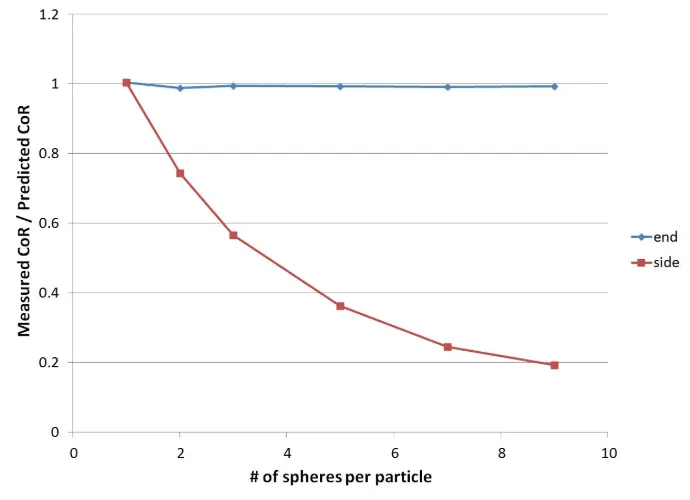
| Bounce | Single particle dropped on its end (1 contact) and on its side (several contacts) | End drops: restitution within 1% of the set value. Side drops: restitution falls with every sphere added, to ≈ 20% of the set value at 9 spheres |
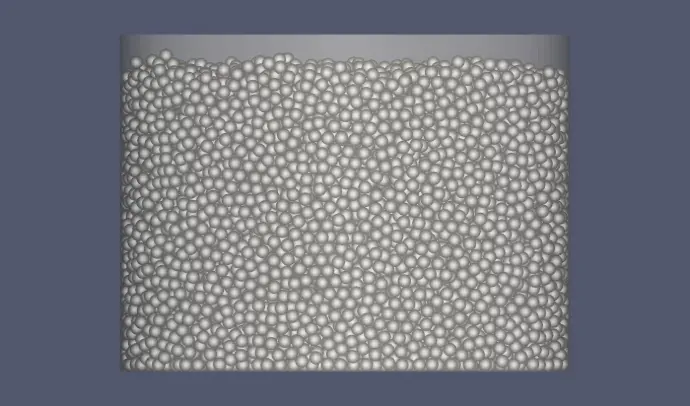
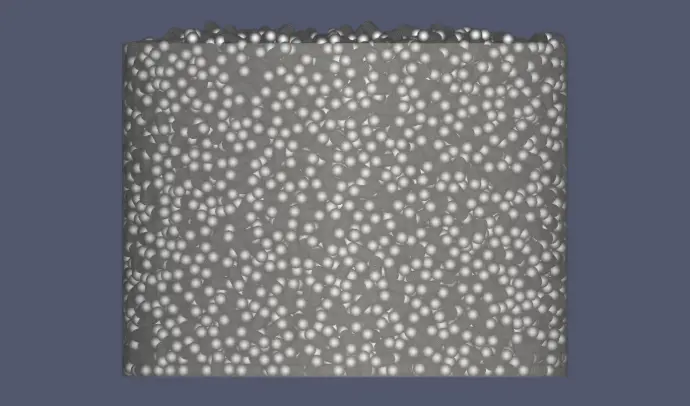
| Packing | 10,000 particles in a 1 L cup | Packing fraction converges from 4–5 spheres on, ≈ 0.59 |
| Angle of repose | 10,000 particles in a narrow slot | 3 to 9 spheres give the same heap profile; 2 spheres match the peak but not the flanks |
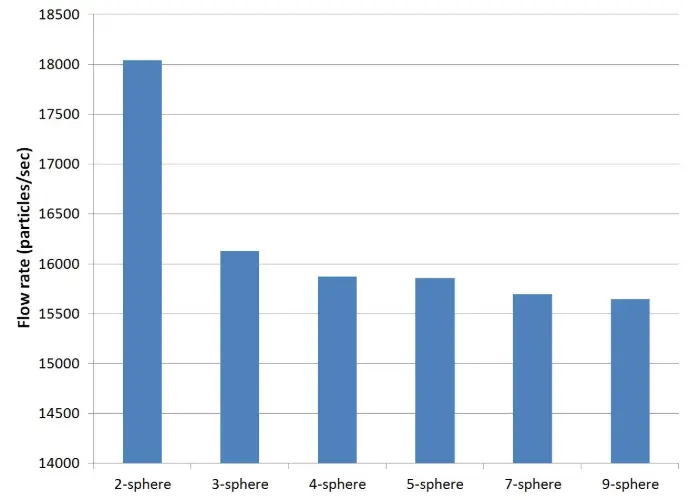
| Hopper flow | 100,000 particles | 2-sphere particles flow ≈ 12–15% faster; 3 to 9 spheres agree within a few percent |
| Paddle mixer | 100,000 particles, Lacey mixing index | Same mixing curve for all; 7 and 9 spheres need ½ and ¼ of the time step |
| Vibrating helical conveyor | Particle stream, hold-up over time | Hold-up by particle count differs, by mass it collapses onto one curve |
| Continuous mixer | Particle stream, hold-up over time | Not conclusive yet; longer runs and smaller time steps under way |
Practical Guidance
- Use at least three spheres for elongated particles. Two spheres misrepresent heap flanks and hopper discharge.
- Mind multi-contact damping. “When there are multiple points of contact, the damping becomes very strong,” the study notes. Calibrate restitution on side impacts, or keep the sphere count low.
- Keep the mass right. A multisphere body has a different volume than the real particle. Adjust the density, and compare feed rates and hold-up on a mass basis.
- Reduce the time step for many highly overlapping spheres; in the paddle mixer, 7 spheres needed half and 9 spheres a quarter of the original step.
Where the contact behaviour itself matters, Aspherix® offers superquadric shapes, which describe a smooth surface with a single contact point per pair. See the particle shapes in the Aspherix® features, or see the calibration workflow for matching restitution and friction to lab tests.
Study and data: Procter & Gamble. Published with permission. Read what our customers say in our references.