Key finding: a virtual calibration chamber built in Aspherix® reproduces the tip resistance of a documented cone penetration test (CPT) in Ticino sand, and then shows how a shaft that expands and contracts makes penetration easier. Julian Tao, Associate Professor at Arizona State University, ran the study himself after trying the software.
Why DEM for Soil–Penetrator Interaction
DEM has become a major research tool in geomechanics. Once it is validated, it gives quantitative insight across scales, from single contacts to the whole sample. Virtual calibration chambers are an established idea, but they are rarely used to study penetrators with different shapes, complex movements and at various scales. Prof. Tao's group had used LIGGGHTS® and CFDEM® before to study internal and surface erosion; for this study they used Aspherix®.
“It offers more user friendly options to install and run the program, especially with the GUI. This can significantly flatten the learning curve for new students.”
Step 1: Calibrating the Sand Against a Real CPT
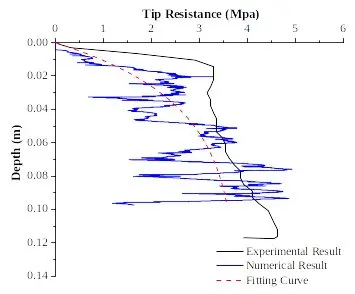
A 3D virtual calibration chamber was built in which the initial soil state, relative density and stress, is prepared with established methods (O'Sullivan 2011). The model was checked against a well-documented CPT in Ticino sand (Butlanska et al. 2010). With suitable parameters, the simulated tip resistance agrees very well with the measured values. The fluctuations in the simulated curve come from the limited number of contacts between the cone and the particles.
Matching a simulation to a lab or field test like this is the core of every reliable DEM model. See the calibration workflow in Aspherix®.
Step 2: A Penetrator That Burrows
The dynamic penetrator has a cylindrical shaft and a conical tip. One cycle has four steps: the shaft expands, the tip penetrates, the shaft contracts to its original diameter, and the shaft follows. The simulation ran at an expansion and contraction frequency of 5 Hz.
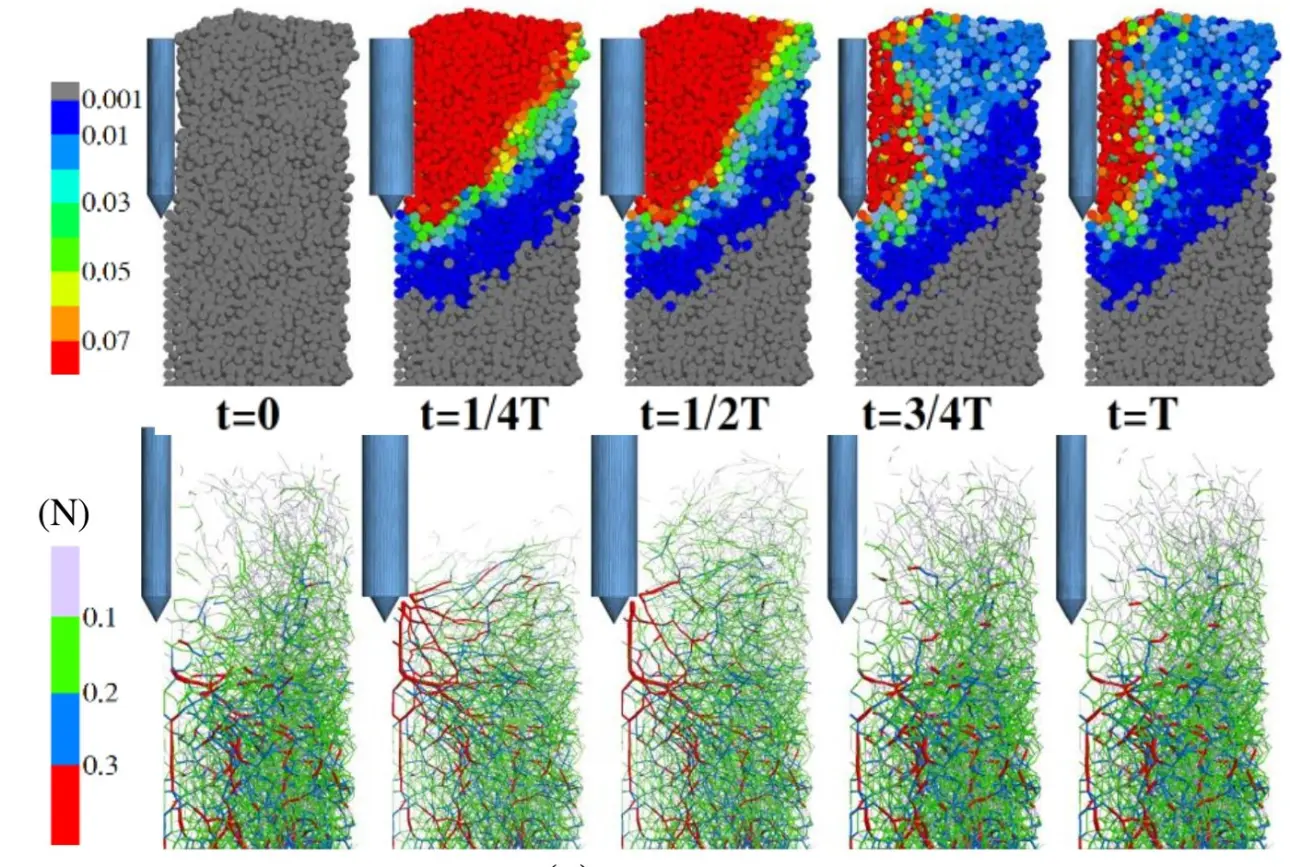
The displacement fields and force chains explain why this works. The expanding shaft pushes the soil sideways and opens space around the cone, so the cone penetrates more easily than in a standard CPT. When the shaft contracts, the particles lag behind and leave a small gap, which lowers the resistance as the shaft moves down. Downward penetration therefore needs less force than direct penetration, at the cost of the energy for expanding the shaft.
Beyond these pictures, the simulation delivers particle trajectories and velocities, stress and strain at the meso scale, and contact and friction forces between particles and penetrator.
For Geotechnical Research Groups
The same workflow applies to other soil–tool interaction problems. Universities can license Aspherix® on academic terms: see Aspherix® Academic. For related industrial work, see the civil and hydraulic engineering cases.
Study and results: Julian Tao, Arizona State University (user report, January 2023). Published with permission.