Following the successful release of our GPU-enabled version, Aspherix® 7.1.0 brings massive performance optimizations, expanded platform support, and sophisticated new modeling capabilities designed to push the boundaries of Discrete Element Method (DEM) simulations.
Aspherix® GPU: Faster than ever and Native on Windows®
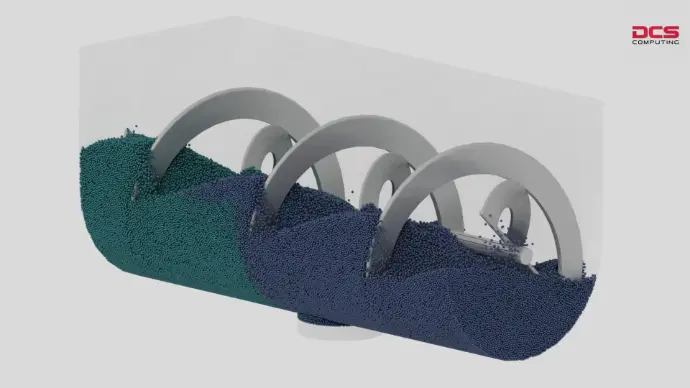
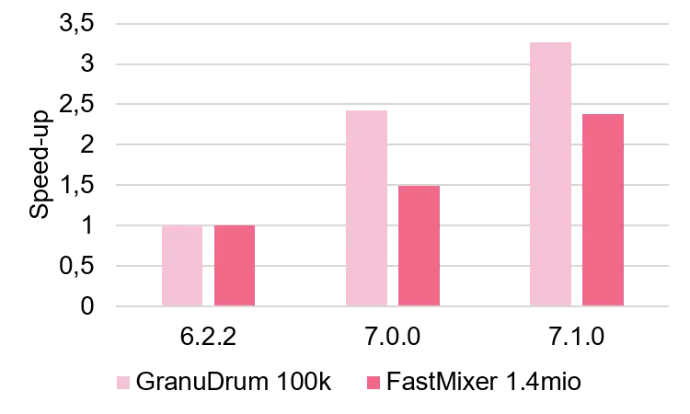
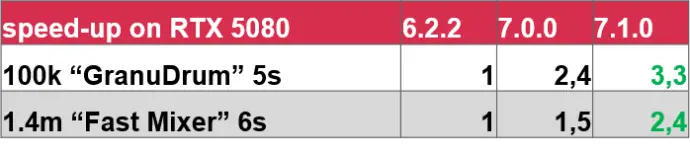
Aspherix® GPU has received significant performance optimizations, focusing on neighbor list management for dynamic cases and reduced memory consumption. On an RTX 5080, version 7.1.0 demonstrates a 3.3x speedup for "GranuDrum" simulations compared to version 6.2.2.
Furthermore, Aspherix® GPU is now available natively on Windows®. This allows users to run GPU-accelerated DEM simulations directly without needing a compatibility layer like WSL or cross-compilation, maintaining the same workflow and results across platforms.
Several NVIDIA architectures are supported, including Turing75, Ampere86, and Blackwell120 (others on request). Additionally, GPU-accelerated simulations can now be run in tandem with CFDEM®coupling using SPUMA, with both solvers running on the GPU (Linux only).
Look Inside Your Particles: Advanced Heat Transfer
Accurately resolving intra-particle temperature is critical for processes involving high Biot numbers.
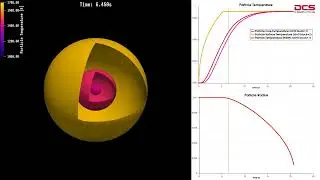
The revised heat transfer model in Aspherix® 7.1.0 allows you to "look inside" particles by discretizing the granulate into shells.
This model tracks temperature distribution for each discretized shell, making it possible to accurately simulate complex thermal transitions, such as melting the outer shell of a particle while the core remains solid
Dynamic Coarsegraining for Computational Efficiency
To maximize computational resources, Aspherix® 7.1.0 introduces an improved version of Dynamic Coarsegraining.
This feature massively speeds up simulations by focusing model detail where it has the most impact.
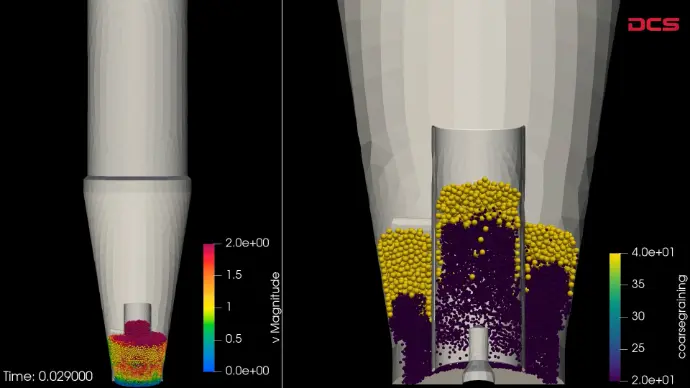
Particles are dynamically refined in active regions and coarsened in less critical areas, all while preserving the underlying physics.
In applications like a Wurster coater, this approach can save up to 8x in computational effort.
Accurate with Built-in Parameter Calibration
Aspherix® Calibration helps to automatically find the correct model parameters for your material.
Choose from a wide set of calibration templates that has now been extended to calibrate parameters for
- Contact models
- Drag
- Wear
- Soil model
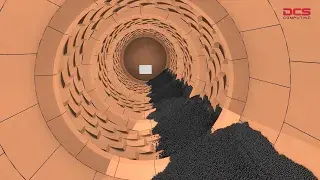
This capability has already been proven in industrial applications, such as a partnership with Treibacher Industrie AG to optimize rotary kiln operations by calibrating DEM microscale properties against lab-scale experimental measurements (read the blog articles on the calibration of DEM models and wear modeling).