Introduction
Surface wear is a common cause of equipment failure in a variety of industries, such as agriculture, mining and automotive.
Tractors, plows, excavators, conveyor systems, engines and brakes are subject to erosive and abrasive friction, as well as impacts that result in severe deformation and breakage; see Video 1.
Thus, the accurate prediction of surface wear is crucial for optimizing maintenance schedules, extending components' lives and reducing downtime, which ultimately lead to improved safety, lower replacement costs and increased efficiency.
Through a joint effort involving DCS Computing, our academic partner Otto-von-Guericke University Magdeburg, and a prominent industrial company, a new wear prediction framework was developed, implemented and experimentally validated. The framework is based on the wear model developed recently by Roessler and Katterfeld [1].
A Universal Wear Model
Video 1: Aspherix® allows the simulation of soil plowing and equipment wear. The selection of model parameters plays a paramount role as well, therefore DCS Computing developed Aspherix® Calibration, a module designed for the calibration of DEM model parameters.
The Rossler-Katterfeld model captures the physics of distinct wear mechanisms, such as:
- sliding
- impact cutting
- and plastic deformation
hence allowing a general and robust modelling framework capable to reproduce the wear for a broad variety of operating conditions, geometries and materials.
Combining the Roessler-Katterfeld model with our innovative DEM calibration technology, the model coefficients corresponding to different material properties and equipment geometry are obtained, and the pointwise wear at different locations of the equipment is accurately predicted. A time-stretching technique was also developed, to extrapolate DEM simulation results from seconds to months of operation.
The new wear prediction framework comes with Aspherix® Calibration 7.0.1 as the new calibration template Wear, and demonstrates one of our core missions: providing industry with the most recent scientific advancements in the field of particle technology.
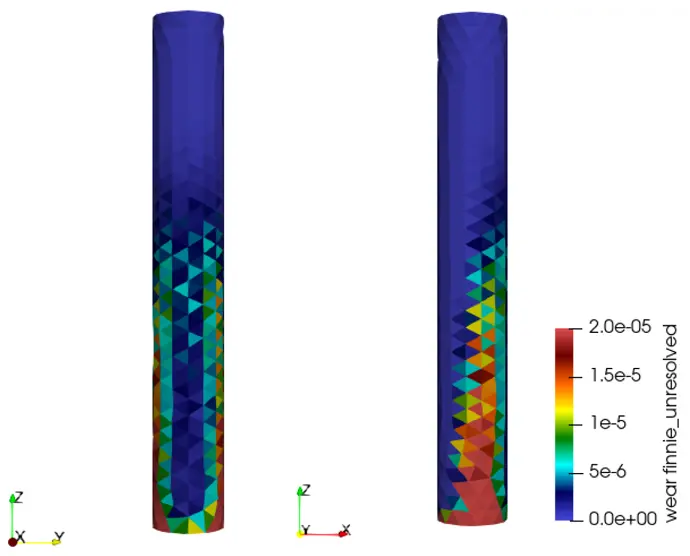
Figure 1: This simulation, performed with Aspherix® DEM, shows a wear test, where cylinder is submerged in a particle bed and subsequently dragged horizontally at constant velocity.
Calibration of a DEM model for equipment wear with Aspherix® Calibration 7.1.0
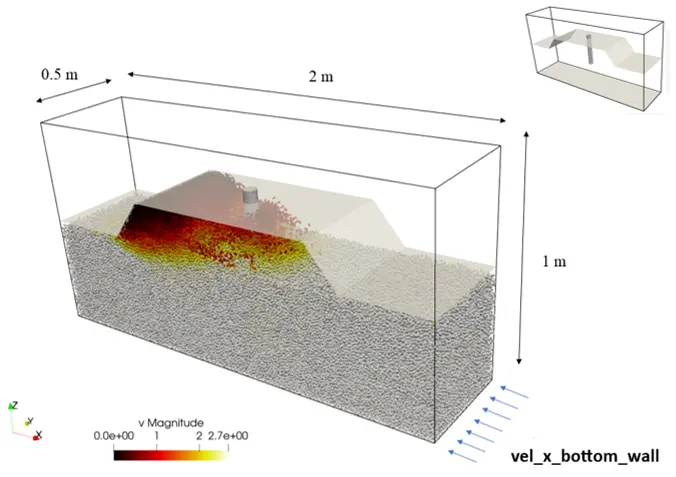
Figure 2: the Rossler–Katterfeld wear model can be calibrated using the new wear calibration template, to be released with Aspherix® Calibration 7.1.0.
[1] Roessler, T. and Katterfeld, A. Calibrated and Validated Wear Prediction for Bulk Material Handling Equipment using DEM Simulations. ICBMH2023 - The 14th International Conference on Bulk Materials Storage, Handling and Transportation 11-13th July, 2023, Wollongong, New South Wales, Australia.
References
The Rossler–Katterfeld model is calibrated by simulating a cylindrical element (Figure 2) moving through a particle bed at a prescribed constant velocity. Longitudinal and lateral periodic boundary conditions are employed to reduce the number of particles required in the simulation, thereby minimizing computational cost while maintaining representative particle–tool interactions. The calibration framework supports both spherical and multi-sphere particle representations.
During the calibration process, multiple combinations of model parameters are evaluated to minimize the discrepancy between simulated wear predictions and experimental reference data.
If you want to know more about DEM calibration and DCS success stories in this sector, we invite you to read the blog article Calibration of DEM Models - Two Customer Success Stories.
Do you want to know more?

The Author:
Riccardo Togni, PhD
Senior Model Developer and Consultant at DCS Computing GmbH.