The need for calibration
The Discrete Element Method (DEM) is used to model the behavior of granular materials by solving the equations of motion, based on Newton’s second law, for each individual particle. The contact force between particles, or between particles and walls, is typically represented using either a linear Hookean spring model or a nonlinear Hertzian spring model acting along the contact normal.
The DEM model relies on a set of microscale parameters for closure. These parameters may include physical properties, such as density, static friction coefficient, and Young’s modulus, as well as non-physical parameters, such as the rolling friction coefficient.
A calibration step is often required to ensure that the selected microscale parameters produce realistic macroscale material behavior, such as bulk density or angle of internal friction.
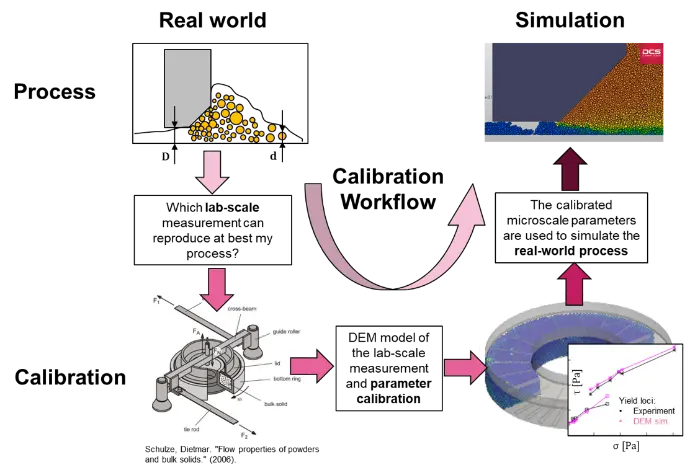
The calibration is commonly performed by simulating standard bulk solid tests for different combinations of microscale parameters and comparing one or more simulation observables with the corresponding experimental reference values (see Figure 1).
Figure 1: Calibration workflow for modeling a recoater system used in additive manufacturing, where shear cell measurements serve as the reference dataset. The particle–particle friction coefficient is calibrated to maximize agreement between the simulated and experimentally obtained yield loci.
A selection of standard bulk solid tests
Static angle of repose test
The static angle of repose test or slump test consists of a cylindrical container filled with a granular material, whose side walls are lifted at a prescribed velocity (see Video 1). As the container is removed, the material forms a heap. The inclination of the resulting heap shape, referred to as the static angle of repose, serves often as reference values for calibration. This test is particularly sensitive to the particle–particle rolling friction coefficient and is therefore commonly used to calibrate this parameter.
Inclined plate test
In the inclined plate test, particles are placed on a flat surface that is gradually tilted. The minimum angle at which the particles begin to roll or slide, the target angle, is recorded. This setup is especially sensitive to particle–wall static and rolling friction coefficients and is widely used for their calibration.
Video 1: This simulation, performed with Aspherix® DEM, shows a slump test, where a non-cohesive granular material flows out from a lifting cylinder.
Rotating drum test
The rotating drum test uses a cylindrical vessel rotating around its longitudinal axis at a constant or variable speed while partially filled with a granular material. Different flowability measurements can be performed, including avalanche and hysteresis tests. Key observables are the dynamic angle of repose and the fluctuation of the interface (see Video 2). The dynamic angle is mainly influenced by particle–particle rolling friction, whereas surface fluctuations are strongly affected by particle cohesion.
Shear test
The shear test evaluates the flow behavior and strength of bulk materials under load. A powder sample is compressed vertically while shear deformation is applied at a constant velocity, generating horizontal shear stress. This method is commonly used to determine the yield behavior of bulk solids, often represented by the yield locus in bulk solids technology (see Figure 1).
Video 2: This video demonstrates how rotary drum measurements, obtained with the GranuDrum (Granutools), can be used to calibrate a DEM model of a free-flowing powder using Aspherix® Calibration.
Success Story #1: Calibration of a DEM model for agricultural soil
DCS has extensive experience in DEM simulation of agricultural soils and their interaction with tillage and excavation tools. In this field, DEM model calibration is particularly challenging due to the complex rheological behavior of soils and their strong spatial and temporal variability.
In a recent collaboration, DCS Computing supported PÖTTINGER Landtechnik GmbH in establishing a robust calibration workflow for agricultural soils by combining advanced soil characterization methods with state-of-the-art DEM modeling techniques.
“Thanks to the support of the team at DCS Computing and the use of Aspherix®, we were able to establish an efficient workflow for calibrating different soil types. These models help us virtually validate our designs using digital twins. The strong agreement between simulation and real-world tests gives us the confidence to make our development processes more targeted and effective.”
— Josef Bruckner, PÖTTINGER Landtechnik GmbH
DCS Computing partnered with Treibacher Industrie AG to support the optimization of rotary kiln operations using advanced DEM simulations. The project focused on analyzing bulk material behavior under varying operating conditions in order to improve process understanding and support operational optimization.
To ensure predictive accuracy, the team first calibrated relevant DEM microscale properties—such as particle-particle and particle-wall friction coefficients—using rotating drum, shear cell, and inclined plate tests (see Video 4). These lab-scale experimental measurements were conducted at Treibacher’s facilities and the Technical University of Leoben.
Ultimately, the calibrated DEM model successfully predicted key process performance indicators, including individual particle residence times and axial mass loading distributions along the kiln (see Video 5).
“Calibrating the DEM model with experimental data has allowed us to gain a deeper, more accurate understanding of the material behavior inside the rotary kiln. Thanks to the support and expertise of DCS Computing, we have achieved a high-fidelity process simulation that now allows us to implement targeted optimizations to the entire system."
— Daniel Vallant, Treibacher Industrie AG
Video 3: Aspherix® allows the simulation of soil plowing and equipment wear. It features a large model library that allows to reproduce the complex soil rheology, as well as the wearing. The selection of model parameters plays a paramount role as well, therefore DCS Computing developed Aspherix® Calibration, a module designed for the calibration of DEM model parameters.
Success Story #2: Calibration of a DEM model for rotary kiln applications

Video 4: Inclined plate tests (right) and their DEM representations (left).
Video 5: DEM simulation of a rotary kiln processing a bulk material.
Do you want to know more?

The Author:
Riccardo Togni, PhD
Senior Model Developer and Consultant at DCS Computing GmbH.