Introduction
Agitated filter drying represents a critical terminal stage in the production of active pharmaceutical ingredients (APIs). During this process, a wet-cake (i.e., the product of crystallization and filtration) is dried within a vessel while being subjected to mechanical stirring; see Figure 1. The mechanical loads required to facilitate drying often induce particle attrition, particularly in crystalline APIs with elongated, needle-like geometries.
The ability to predict and mitigate this attrition across various scales is a primary challenge for the pharmaceutical industry. Because compressive and shear forces increase by orders of magnitude as mass loads shift from lab-scale to plant-scale, traditional laboratory experiments often fail to accurately replicate industrial-level particle degradation.
The hybrid modelling approach
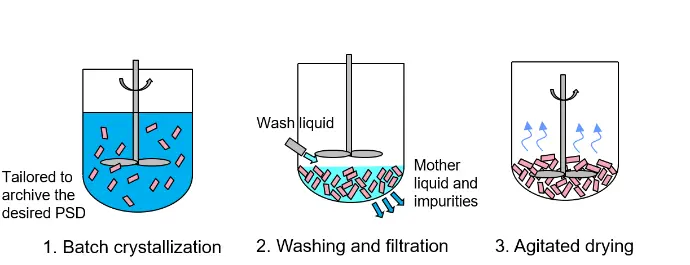
Figure 1: Representation of the main steps in API production.
A collaborative research effort involving DCS Computing and several global pharmaceutical leaders, including AstraZeneca, GSK, Merck, Pfizer, Bristol Myers Squibb, and Genentech, has resulted in a novel modeling workflow designed to predict the attrition of elongated particles during agitated drying. This workflow integrates two distinct numerical methods:
- Discrete Element Method (DEM): Utilizing Aspherix® software, DEM simulations model granular flow and contact forces to estimate the mechanical torque at the agitator’s shaft.
- Two-Dimensional Population Balance Equation (2D-PBE): This model utilizes the torque and the evaporation profile data derived from DEM as primary input to calculate the resulting evolution of the particle size distribution (PSD) [1].
Video 1: This Aspherix® DEM simulation shows a wet-cake undergoing agitation and drying in a lab-scale agitated filter dryer. The powder's cohesivity changes with the residual solvent content, affecting the rheology of the wet-cake.
Key findings
The research focused on L-Threonine, an amino acid with needle-shaped crystals prone to fragmentation. The study yielded several critical insights into the efficacy of DEM-PBE modeling:
- Role of simulated torque: While experimental torque data is often complex and highly variable, the study demonstrated that a statistical steady-state torque derived from DEM is sufficient to predict attrition accurately.
- Model Efficiency: To simulate the drying of a wet-cake, researchers successfully compressed six hours of experimental time into a 60-second simulation by dynamically adjusting cohesion parameters to reflect decreasing solvent content; see Video 1.
- Predictive Accuracy: The final particle length distributions predicted by the 2D-PBE model showed reasonable agreement with experimental measurements for both dry and wet material conditions; see Figure 2.
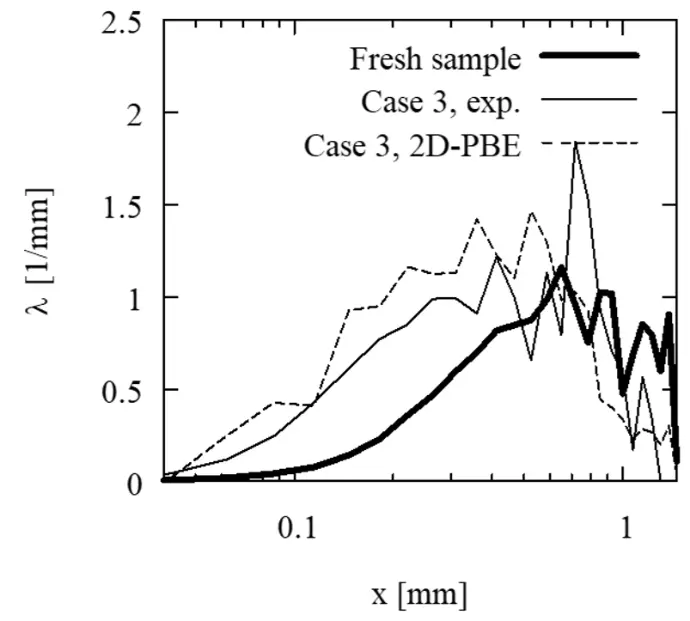
Figure 2: Length distribution of L-Threonine measured before (thick solid line) and after (thin solid line) the agitation experiment. The length distribution predicted by the calibrated 2D-PBE model is represented as a dashed line.
Impact on process development
This research, supported by the Enabling Technologies Consortium (ETC) [2], underscores the value of reduced-order modeling in pharmaceutical process development.
By utilizing Aspherix® to simulate the particle dynamics and solvent evaporation, engineers can create in-silico the input required by the 2D-PBE, bridging the gap between equipment at lab- and commercial-scale.
This "digital twin" nature of the 2D-PBE enables the industry to optimize equipment design and operating conditions, ultimately ensuring that the final API maintains its target physical properties and bioavailability.
1. Togni, Riccardo, et al. "A two-dimensional population balance model for predicting the attrition of elongated particles during agitated drying." Powder Technology 464 (2025): 121198, https://doi.org/10.1016/j.powtec.2025.121198
2. Enabling Technologies Consortium, Official website. https://www.etconsortium.org, 2025 (accessed April, 2026).