For the Discrete Element Method (DEM) community, LIGGGHTS® has long served as a reliable open-source foundation. While LIGGGHTS® established a high standard with its last official release in 2017, Aspherix® represents the next stage of that journey - delivering the advanced performance, unmatched usability, and model fidelity needed to push industrial boundaries even further.
Dozens of years of development have been invested in Aspherix®, a professionally supported platform rooted in LIGGGHTS® but built upon fundamentally new software architectures. For researchers and engineers looking to advance their simulation capabilities, Aspherix® offers a validated path forward, combining a significantly expanded feature set with a modern user experience.
Architectural and Feature Evolution
At a high level, Aspherix® represents a shift from a script-centric solver to a comprehensive simulation ecosystem. While LIGGGHTS® relies heavily on complex input scripts and command-line execution, Aspherix® introduces a modern graphical user interface (GUI) and an input language designed for clarity and usability.
Key functional differences include:
Advanced Physical Modelling: Aspherix® extends beyond standard DEM by offering native support for complex particle shapes, chemical reactions, and magnetic dipoles. It also integrates electrical and radiation modelling capabilities, alongside an expanded library of advanced material models.
Flexible Computing & High Performance: Unlike traditionally Linux-centric tools, Aspherix® is available on both Linux and Windows for CPU-based tasks. Additionally, Aspherix® offers a GPU-accelerated version that enables high-performance simulations and significantly reduces computation times.
Proven Stability & Precision: Engineered for mission-critical R&D, Aspherix® incorporates extensive bug fixes and advanced simulation control features to ensure maximum data integrity and numerical robustness.
Customization: Leveraging deep domain expertise, the DCS team provides substantial value to corporate users by delivering custom models and extensions with high quality and rapid turnaround.
Rotary kiln DEM simulation with Aspherix®: accurately predicting mixing efficiency and residence time distribution (link).
Performance and Speedup
A primary motivation for transitioning to Aspherix® is its ability to handle increasingly large and complex systems through superior computational efficiency on both CPU and GPU architectures.
Performance Optimization (CPU): Even in standard CPU-based environments, Aspherix® achieves best-in-class performance through highly optimized parallelization. This technical advantage has been demonstrated in industrial benchmarks conducted by Procter & Gamble, where Aspherix® successfully resolved bottlenecks associated with complex geometries and large-scale simulations.
GPU Acceleration and Benchmarks: The most transformative performance gains are achieved with the Aspherix® GPU version (Linux). While currently supporting a focused feature set, it is fully optimized for relevant industrial applications, delivering massive speedups for complex particle flow and material handling processes. This ensures that the most computationally intensive tasks—where speed is most critical—benefit from modern hardware acceleration (NVIDIA GPUs), reaching performance levels previously attainable only on large CPU clusters.
Massive Speedups: In validation studies of a rotating drum mixer, the Aspherix® GPU version significantly outperformed LIGGGHTS®.
Hardware Efficiency: Benchmark results indicate that a single modern consumer GPU, such as an RTX 5080, can outperform a cluster of 32 CPU cores.
Recent Breakthroughs: With the release of Aspherix® 7.0.0 in December 2025, performance has been further optimized, delivering an additional 2–3× speed increase for benchmarked cases.
Result Consistency: Aspherix® guarantees identical results between CPU and GPU versions, ensuring a validated and reliable workflow for high-fidelity simulations.
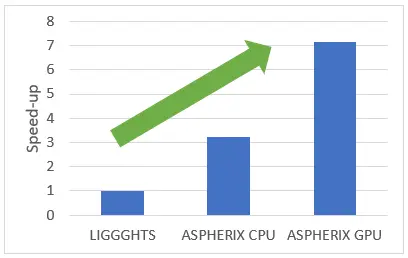
Performance gain identified by the benchmark studies.
A Trajectory of Continuous Development
The Aspherix® roadmap is closely aligned with ongoing hardware advancements. Following the successful December 2025 release, planned milestones for 2026 and 2027 include AMD GPU compatibility, native Windows support for GPU solvers, and expanded CFD coupling.
A key development focus remains the optimization of neighbour-list algorithms for highly dynamic systems, further reducing runtimes for complex mixing and agitation processes.
Exploring the Transition
The transition from LIGGGHTS® to Aspherix® has already been embraced by DCS’s entire former LIGGGHTS® user base, signalling a decisive industry shift toward a more powerful and future-proof simulation ecosystem. For teams currently constrained by the limitations of legacy codebases, evaluating how Aspherix®’s performance gains and expanded physics capabilities align with upcoming projects is the next logical step.