Introduction
For years, LIGGGHTS® has served as a cornerstone of the open-source Discrete Element Method (DEM) community. However, as industrial simulation demands more complex models applied to millions of particles, legacy codebases can face significant performance bottlenecks.
To address these limitations, Aspherix® was engineered to deliver advanced computational efficiency, cross-platform robustness, and modern hardware acceleration without compromising numerical precision.
To demonstrate this technical leap forward, a comprehensive benchmarking study was conducted to evaluate the performance of Aspherix® (v. 7.0.0, both CPU and GPU implementations) against LIGGGHTS-public across three distinct, common industrial bulk solid processes. Here is how the solvers compare.
The benchmarking results relative for LIGGGHTS-public have been published by Dosta et al. [1] (see Figure 1).
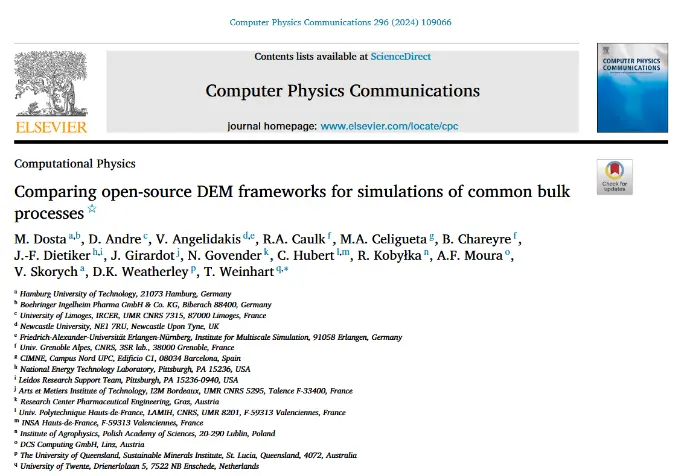
Figure 1: The paper from Dosta el al. [1] compare different open-source DEM solutions, including LIGGGHTS®.
Validation Study 1: Silo Emptying
Silo discharge is a classical benchmark for mass flow and gravity-driven particle handling, involving high-friction interactions and dense packing configurations. This case study tracked the discharge of 100,000 particles from a cylindrical steel silo. The simulations analyzed variations across two orifice sizes (small and large) and two distinct material types (M1 and M2).
Result Consistency: Both solvers yielded identical physical and numerical results, validating the correctness of the underlying contact models in Aspherix®.
CPU Performance: Running on equivalent parallel setups (16 MPI processes), Aspherix® significantly outperformed LIGGGHTS®, achieving a speedup factor between 3.5× and 4.5× depending on the specific time step setup (Figure 2)
GPU Capabilities: Even using the first (unoptimized) version of the Aspherix® GPU solver, hardware acceleration delivered a 2× to 2.8× speedup compared to LIGGGHTS® on the CPU.
Efficiency: The floating-point operations per second (FLOPS) remained identical across the configurations, confirming that the speed gains stem entirely from superior algorithmic efficiency and code optimization.
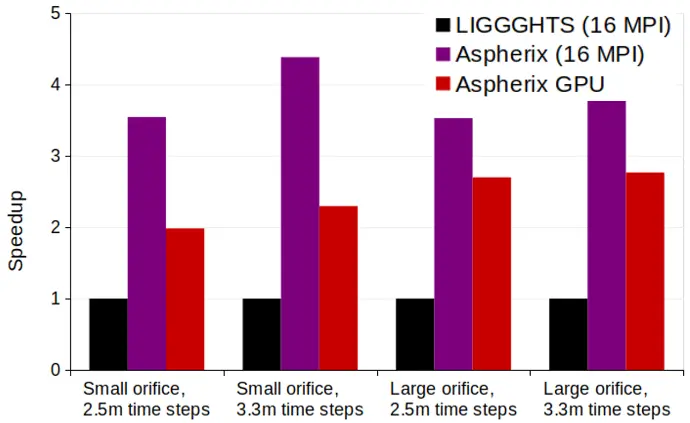
Figure 2: Performance benckmark of Aspherix® (v. 7.0.0) vs. LIGGGHTS-public using the silo test. The FLOPS count is identical for all cases.
Validation Study 2: Rotating Drum Mixer
Particle mixing in rotating drums is highly dynamic and a staple configuration in pharmaceutical, chemical, and agricultural engineering. This benchmark modeled the motion of two distinct particle types (totaling 38,000 particles) inside a rotating drum mixer to evaluate dynamic neighbor-list updates and contact detection.
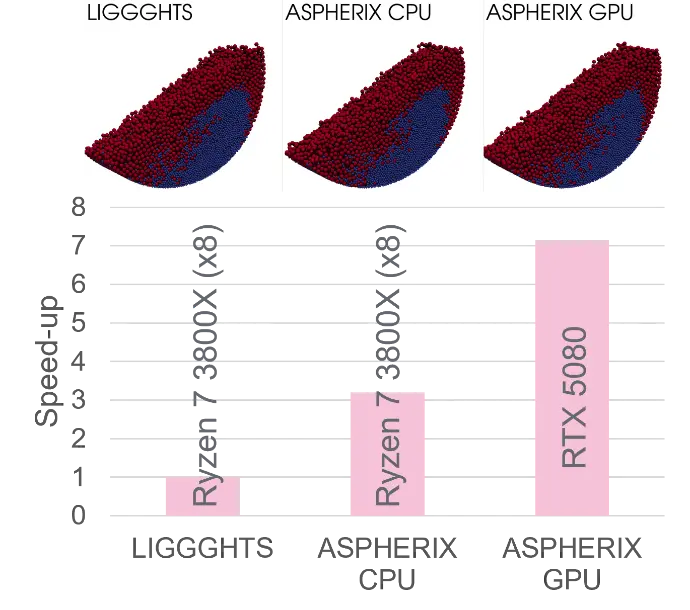
The Setup: The benchmark compared standard multi-core processing against modern desktop hardware acceleration, utilizing an NVIDIA RTX 5080 GPU and an 8-core AMD Ryzen 7 3800X CPU.
The Breakthrough: While yielding identical physical mixing dynamics, Aspherix® demonstrated clear computational dominance.
Massive Speedups: The Aspherix® GPU implementation not only substantially outperformed standard CPU architectures, but it also outpaced LIGGGHTS® by a factor of 7. This underscores the immense power of moving intensive mixing simulations onto dedicated consumer GPU hardware.
The third validation study focused on highly localized energy dissipation and impact dynamics—critical for understanding wear, degradation, and penetration. This setup simulated a single steel particle impacting and penetrating a static bed with a varying inventory of particles (25,000, 50,000, and 100,000 particles).
Physical Validation: Once again, the physical trajectories and penetration depths between Aspherix® and LIGGGHTS® matched identically.
CPU and GPU Scaling: On standard CPU architectures, Aspherix® delivered a baseline performance similar to LIGGGHTS®. However, the GPU solver version easily outpaced CPU execution, indicating excellent scaling properties as the static bed grew larger.
Algorithmic Integrity: Because the FLOPS count remained identical across the software suites, users can rest assured that speed enhancements are achieved through clever architecture rather than numerical shortcuts.
Figure 2: Performance benckmark of Aspherix® (v. 7.0.0) vs. LIGGGHTS-public using the drum mixer test. The FLOPS count is identical for all cases.
Conclusions
The results across these three validation studies deliver a clear message: transitioning from LIGGGHTS® to Aspherix® provides a significant, validated leap in computational throughput. Whether leveraging standard parallelized CPU architectures or unlocking the massive parallel processing power of modern NVIDIA GPUs, Aspherix® ensures that engineers can run larger, longer, and more complex simulations in a fraction of the time. Turnaround times drop dramatically, letting teams focus less on waiting for numbers to crunch and more on optimization and design.
[1]: Dosta, M., Andre, D., Angelidakis, V., Caulk, R. A., Celigueta, M. A., Chareyre, B., ... & Weinhart, T. (2024). Comparing open-source DEM frameworks for simulations of common bulk processes. Computer physics communications, 296, 109066.
Validation Study 3: High-Velocity Particle Impact
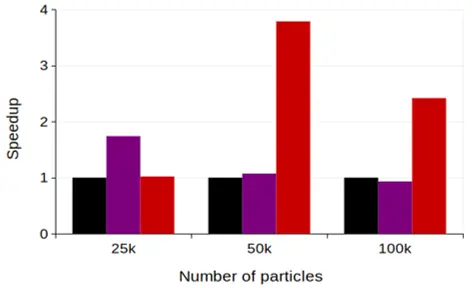
Figure 3: Performance benckmark of Aspherix® (v. 7.0.0) vs. LIGGGHTS-public using the impact mixer test. The FLOPS count is identical for all cases.
References
Do you want to know more?

The Author:
Riccardo Togni, PhD
Senior Model Developer and Consultant at DCS Computing GmbH.